Bacteria belonging to the United 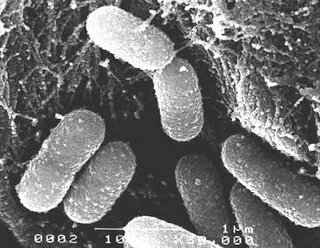 moneras Monera or one of the five kingdoms in which they grouped the various beings that inhabit our world, according to the classification used and accepted internationally. This Kingdom is composed not only bacteria, also belong to he calls blue-green algae.
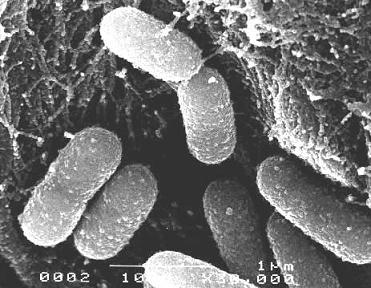 moneras Monera or one of the five kingdoms in which they grouped the various beings that inhabit our world, according to the classification used and accepted internationally. This Kingdom is composed not only bacteria, also belong to he calls blue-green algae.
 This Kingdom, rich in species diversity, groups of organisms called prokaryotes by having a named prokaryotic cell type lacking core surrounded by membrane. In laboratory studies have found that only one circular chromosome and ribosomes that sediment at 70S while eukaryotes do to 80S. When observed by electron microscopy confirms the absence of organelles surrounded by membranes.
Members of this kingdom shall be considered the first settlers or forms of life on Earth, scientific research argue that existed for 3,500,000,000 years ago is that they could be prevailing in the early atmosphere. The formation of oxygen limited to anaerobic environments bacteria (methanogens) or extreme conditions (thermoacidophiles halophilic bacteria and bacteria).
The Monera are single-celled autotrophs or heterotrophs can be found in all environments, some bacteria are truly amazing places like thermophilic bacteria, the bacteria can be stationary or mobile, have the rigid wall asexual reproduction, although they may have genetic information exchanges between individuals of the same species or different species.
The Monera are single-celled autotrophs or heterotrophs can be found in all environments, some bacteria are truly amazing places like thermophilic bacteria, the bacteria can be stationary or mobile, have the rigid wall asexual reproduction, although they may have genetic information exchanges between individuals of the same species or different species.
Match of the Monera. The eubacteria and archaea
Eubacteria are divided into Gram Gram positve and negative, depending on whether or not stained with Gram stain or reagent.
The Gram +: May be harmful, such as Clostridium botulinum, and beneficial, as Tactobacillos.
The Gram - : May be harmful, such as Treponema pallidum or beneficial as Rhyzobium. The cell wall can not be mycoplasmas as Mycoplasma Pallidum.
can be photosynthetic or chemosynthetic heterotrophs. Among the latter are the saprophytes that cause putrefaction to ferment and parasitic pathogens.
The Gram +: May be harmful, such as Clostridium botulinum, and beneficial, as Tactobacillos.
The Gram - : May be harmful, such as Treponema pallidum or beneficial as Rhyzobium. The cell wall can not be mycoplasmas as Mycoplasma Pallidum.
can be photosynthetic or chemosynthetic heterotrophs. Among the latter are the saprophytes that cause putrefaction to ferment and parasitic pathogens.
Archaea may be:
methanogens: are anaerobic bacteria. Reduce CO2 carbon dioxide and release methane CH4.
halophilic : These bacteria are found in environments with high salt concentrations.
thermoacidophiles: bacteria living in acidic hot springs.

